Journal · 28 August 2026 · 10 min read
What is a saree? A complete beginner’s guide
What Is a Saree? A Beginner's Guide to Six Yards of Craft
The Saree, Simply Put
A saree is not stitched. It is draped — the way a story is told, one fold at a time.
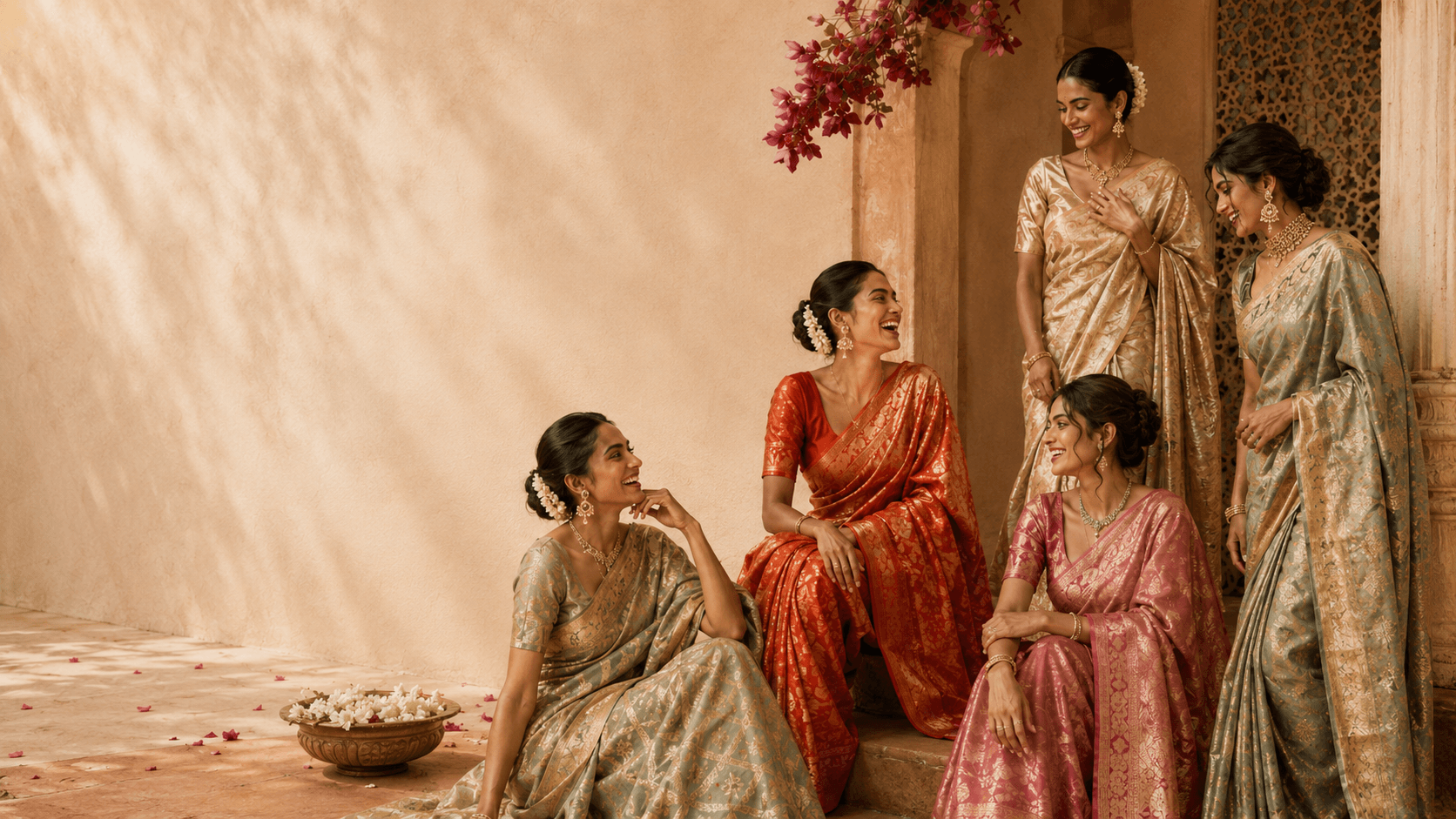
For thousands of years, women across India have reached for a single length of unstitched fabric and turned it into presence. No buttons. No seams. No fixed shape. Just six yards of cloth, a blouse, a petticoat, and the woman who brings them to life. That is the quiet genius of the saree: it does not announce itself. It lets the woman wearing it become the statement.
This guide is for her — the woman discovering the saree for the first time, or returning to it with new eyes. Ready to understand the fabric, the drape, the craft, and how to make six yards entirely her own.
The Saree's Story: Five Thousand Years in the Making
Long before fashion had a name, there was the drape.
The saree is one of the oldest garments still worn today, with roots that reach back more than five thousand years — to the sculptures, scriptures, and artistry of the Indus Valley Civilisation. What followed was centuries of reinvention. Every kingdom, every region, every pair of weaver's hands added something of its own: a motif, a technique, a way of folding the cloth that belonged to one place alone. The saree we know today is the sum of all of it — heritage, refined and handed forward.
And it is handed forward, often literally. A saree carries memory. It appears at festivals and weddings, at the ceremonies that mark a life, gathering stories with every wear. A grandmother's pallu becomes a granddaughter's first drape. The craft stays while the woman changes. That is how heritage is meant to live — not preserved behind glass, but draped, worn, and made new again.
Anatomy of a Saree: Knowing the Six Yards
To the untrained eye, a saree is a single piece of cloth. Look closer and it reveals itself as a composition — each section designed with intention, each one carrying its own craft. Traditionally five to nine yards long, a saree is draped around the body and paired with a blouse and petticoat. Knowing its parts is the first step from admiring a saree to truly understanding one.
The Body — The saree's canvas. It covers most of the garment and carries its motifs, prints, embroidery, or woven design.
The Border — The decorative edge that frames the drape, brought to life with zari, thread weaving, temple lines, floral vines, or geometric pattern.
The Pallu — The crescendo. Draped over the shoulder, this is where the weaver saves the finest work: the richest motifs, the most elaborate craft. It is the part everyone remembers.
The Blouse Piece — The fitted top that completes the look, usually woven to complement the saree's colours and pattern. It can match or contrast, and the blouse back is a statement entirely its own.
The Petticoat — The quiet architecture beneath. The fitted underskirt into which the saree is tucked, giving the drape its shape and holding it through the day.
Together, these elements turn a length of fabric into a single, considered piece of artistry.
How to Drape a Saree: The First Time, and Every Time After
The first drape can feel like a mystery. The hundredth feels like second nature. Between the two is nothing more than a little practice. The most loved method across India is the Nivi drape — graceful, forgiving, and the perfect place to begin.
1. Tuck — Tuck one end of the saree into the petticoat at the front, just right of centre, and wrap it once fully around the waist.
2. Wrap — Continue around the body, keeping the lower edge at an even length above the floor.
3. Pleat — Gather five to seven neat, even pleats from the remaining fabric and tuck them into the front of the petticoat, facing slightly left.
4. Drape the Pallu — Bring the remaining fabric around the back and over the left shoulder. Leave it loose, pin it in place, or style it as the moment calls for.
This is one way of many. Across India, the same six yards are draped in more than eighty distinct styles, each rooted in the culture it comes from. Master the Nivi first — the rest of that world will be waiting.
Choosing Your Fabric: Where Every Saree Begins
Before the motif, before the border, before the drape, there is the cloth. Fabric decides how a saree feels in the hand, how it falls against the body, and how easily it moves with a woman through her day. For a first saree, the gentlest fabrics are the most rewarding.
Cotton — Breathable and effortless, made for daily wear and warm days.
Georgette — Light and flowing, forgiving to drape, with a fall that suits almost any occasion.
Chiffon — Sheer and graceful, at ease at parties and semi-formal evenings.
Silk — The language of luxury, woven for weddings and the moments that matter most.
Organza — Crisp and structured with a sheer finish, quietly modern in its styling.
Linen — Understated and refined, as ready for the office as for everything after.
Viscose — Soft as silk and easy to care for, made for everyday grace.
The Right Saree for the Right Moment
A saree meets a woman where she is. The same six yards can carry her through a Monday morning or a once-in-a-lifetime evening — the art is in the choosing.
For Work and Every Day — Cotton, linen, and viscose. Light, breathable, and made to be lived in. Clean patterns, soft colour, and a restrained hand keep the look refined from the first meeting to the last.
For Festivals and Family — Silk, soft silk, tussar silk, and handloom. Rich colour and heritage motifs — zari work, temple borders, butta designs — bring festive warmth and honour the meaning of the day.
For Weddings and the Grandest Evenings — Kanchipuram silk, Banarasi silk, Patola, georgette, chiffon, and organza. Intricate embroidery, fine detailing, and elaborate craft create a look that arrives before she does.
The Sarees of India: A Region-by-Region Guide
India's textile heritage is unmatched, and every region tells its story in cloth. From silk woven for royal occasions to handloom made for everyday grace, each saree below carries the craft of the place it comes from.
Kanchipuram (Tamil Nadu) — Pure silk with rich texture, vivid colour, and intricate zari. The wedding saree by which others are measured.
Banarasi (Varanasi, Uttar Pradesh) — Opulent brocade and Mughal-inspired motifs. Among the finest sarees a bride can wear.
Patola (Gujarat) — The rare double ikat weave. Months of mastery in a single drape.
Pochampally Ikat (Telangana) — Striking geometric design and a signature dyeing craft. Heritage with a modern edge.
Chanderi (Madhya Pradesh) — Sheer, luminous, and feather-light. Elegance you can wear for hours.
Jamdani (West Bengal & Bangladesh) — Floral and geometric motifs woven into the cloth itself. A handwoven masterpiece.
Paithani (Maharashtra) — Vivid colour and the unmistakable peacock motif. Royal heritage, woven thread by thread.
Tussar Silk (Jharkhand & Bihar) — Natural silk with a textured, earthy sheen. Refined and grounded.
Mysore Silk (Karnataka) — Smooth, light, and effortless to drape. Quiet luxury for festive and formal days.
Maheshwari (Madhya Pradesh) — Signature stripes, checks, and elegant borders. Simplicity, beautifully made.
Sambalpuri (Odisha) — Ikat weaving in intricate pattern and vivid colour. Odisha's heritage, drape-ready.
Baluchari (West Bengal) — Silk that tells stories, with motifs drawn from myth and history. Artistry you can read.
Dhakai (Bengal) — Featherlight and finely woven. Exceptional skill in its most delicate form.
Bomkai (Odisha) — Elaborate borders and an expressive pallu. Tribal artistry meets refined weaving.
Kota Doria (Rajasthan) — The signature square-check weave, airy and light. Made for warm days.
Muga Silk (Assam) — Assam's prized golden silk, naturally lustrous and remarkably durable. Luxury and heritage in one.
Bhagalpuri Silk (Bihar) — Soft, natural, and easy to wear. As at home at a celebration as on a quiet evening.
Gadwal (Telangana) — A cotton body married to a silk border. Light to wear, rich to look at.
Chettinad Cotton (Tamil Nadu) — Bold colour, confident checks, and contrasting borders. Comfort with character.
Narayanpet (Telangana) — Handwoven and light, with clean borders and vivid shades. Effortless and enduring.
Linen — Breathable, understated, refined. As ready for the office as for the everyday.
Organza — Sheer and crisp, structured yet graceful. A modern favourite.
Georgette — Soft, flowing, and easy to drape. The elegant silhouette of choice for evenings.
Chiffon — Light and graceful, with a beautiful fall. At ease in any setting.
Cotton — Breathable, versatile, timeless. The everyday saree for every woman.
Soft Silk — The richness of silk with a lighter touch. Made for festivities and family.
Art Silk — The look and feel of silk, with effortless wear and easy care.
Bandhani (Gujarat & Rajasthan) — The celebrated tie-dye craft of western India, in colour and pattern that delight.
Kalamkari (Andhra Pradesh) — Hand-painted and block-printed artwork, each saree a story told in motif. A wearable work of art.
Printed — Modern and endlessly versatile, in florals, abstracts, and digital design. Contemporary style with everyday ease.
Caring for Your Saree: Made to Be Passed On
A fine saree is beauty meant to last — sometimes for generations. A little intention keeps colour vivid, fabric strong, and craft intact, long enough to hand forward.
Washing — Keep silk and heavily embroidered sarees to professional dry-cleaning. Cotton and georgette can be hand-washed gently in cold water with a mild detergent. Avoid wringing or twisting the fabric.
Drying — Always dry in the shade. Direct sun fades colour and weakens delicate fibres over time.
Ironing — Use a low to medium heat. For silk, place a cloth between the iron and the fabric to protect its sheen.
Storing — Fold sarees in clean muslin or soft cotton, and avoid plastic, which traps moisture. Refold from time to time to keep creases from setting. For silk, a neem leaf or a small sachet of silica gel keeps moisture at bay.
Why the Saree Endures
Fashion moves quickly. The saree moves with it — and somehow stays exactly itself.
In a world of changing silhouettes, the saree has done what few garments ever manage: stayed relevant for thousands of years without standing still. New fabrics, new drapes, new ways of wearing it arrive with every generation, and the saree takes them in while holding on to its soul.
It belongs everywhere a woman decides to take it. A red carpet at Cannes. A festival at home. A boardroom on a Tuesday. The saree does not ask her to choose between heritage and the present moment — it lets her carry both at once, with grace.
That is why the saree endures. It was made for her. And it is still being designed for who she is becoming.
Begin Your Saree Story at Kaushah
Every woman's saree journey begins with a single drape. We would be honoured for yours to begin with us.
Kaushah is built on five decades of Shubhsuki's legacy — craft refined over generations, now reimagined by three women who live in both worlds: rooted in culture, designed for today. Our collection brings together silk and cotton, organza and georgette, heritage weaves and contemporary design, so that every woman can find the drape that feels made for her.
Whether this is your first saree or the newest in a collection you have built with love, you will find something here that speaks your language — craft you can feel, beauty you can wear, and a statement that defines the one draping it.
Woven in legacy, draped in you.
— Kaushah
Woven in legacy, draped in you.
Keep reading
More from the Journal


Our Story Continues
A legacy reimagined for the woman of today.
Silk and cotton, organza and georgette, heritage weaves and contemporary design, so every woman can find the drape that feels made for her.